


Wall coverings and paper emerged during 16th century Renaissance Europe amongst the upper-classes as a way to bring colour into their homes. Traditionally, the gentry would use tapestry to achieve bright colours in an otherwise usually dark room, but not all could afford these tapestries and so they turned to wallpaper.

16th century ‘The Cambridge Fragment’ 1509, original block print by Hugo Goes on the reverse of a proclamation of Henry VII
Courtesy wallpaperhistorysociety.org.uk

19th century ‘The Moses Room’ c. 1845 by AWN Pugin, hand printed exclusively for the Palace of Westminster by Cole & Son (Wallpapers) Ltd
Courtesy wallpaperhistorysociety.org.uk
They were not always pasted onto the wall, and sometimes hung like a painting or tapestry but over time pasting became more popular and in England and France wallpaper became widely used. One of the earliest known wallpapers was found in England dating back to 1509. If anyone has an image of this, I would love to see it.

William Morris wallpaper. Photograph: Andreas Von Einsiedel/The National Trust for Places of Historic Interest or Natural Beauty
Now, I could hardly write a feature on wallpaper and not mention William Morris. Morris was the single most influential designer of the 19th century, and remains one of the best known of all British designers today. Born in Walthamstow in 1834 to an affluent middle class family, Morris set up his own textile and wall covering company and began to furnish the homes of the middle classes. and his designs changed the way that people saw wallpaper and it was soon adopted widespread in all homes.
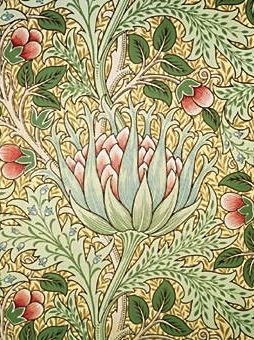
“Artichoke” wallpaper designed by John Henry Dearle for William Morris and Co., circa 1897
Below is a fantastic, if slightly 80s looking, film about wallpaper over the eras. It is a nice short history lesson so well worth a quick view…


RT @ateliertally : NEW blog post: Wallpaper… not just a magazine http://bit.ly/hfEWnY #interiors #wallpaper