Archived entries for paper week

Fashion! Turn to the leftover paper clothes.

Something happened in the 1960s. Fashion really pushed boundaries… Mary Quant’s mini-skirts, go-go boots and PVC clothing. But there was another fashion craze that swept, well almost, the nation: paper clothes. Even Andy Warhol was not safe, having his work repurposed onto paper: “The Souper Dress/No Cleaning/ No Washing/ It’s carefree fire resistant unless washed or cleaned/To refreshen, press lightly with warm iron/80% Cellulose, 20% Cotton” so reads the label in the back of this icon.

11
The Souper Dress, after Warhol, by Campbell’s Soup Company, New Jersey, 1968. Photo: Panos Davios. © ATOPOS collection. Courtesy Barbican International Enterprises


A touring exhibition is currently showing some paper dresses from the 1960s to present day including the Souper Dress (1968) after Andy Warhol; the Yellow Pages paper dress; paper dresses from the 1968 US election campaigns; and the Poster Dresses by American graphic designer Harry Gordon. It is unclear if this exhibition will make it to London, but I do hope so as it looks incredible.

6a0105362716cd970c011168d27cc6970c 800wi

Continue reading…

Wallpaper… not just a magazine

Wall coverings and paper emerged during 16th century Renaissance Europe amongst the upper-classes as a way to bring colour into their homes. Traditionally, the gentry would use tapestry to achieve bright colours in an otherwise usually dark room, but not all could afford these tapestries and so they turned to wallpaper.

16th century
16th century ‘The Cambridge Fragment’ 1509, original block print by Hugo Goes on the reverse of a proclamation of Henry VII
Courtesy wallpaperhistorysociety.org.uk

19th century
19th century ‘The Moses Room’ c. 1845 by AWN Pugin, hand printed exclusively for the Palace of Westminster by Cole & Son (Wallpapers) Ltd
Courtesy wallpaperhistorysociety.org.uk

They were not always pasted onto the wall, and sometimes hung like a painting or tapestry but over time pasting became more popular and in England and France wallpaper became widely used. One of the earliest known wallpapers was found in England dating back to 1509. If anyone has an image of this, I would love to see it.

Continue reading…

Smythson Featherweight

I thought long and hard before deciding to talk about Smythson… I am a fan for sure and my wedding stationery came from this Bond Street mecca but it is almost ubiquitous amongst stationery articles. But this is probably because they cannot be beaten and that should be celebrated.

In 1916, a man named Frank Smythson created a paper that was so thin and light yet still able to take a fountain pen ink that he copyrighted this paper and included it within his stationery.

SmythsonLogo 1

Smythson books banner

Since then many have imitated the Smythson style and quality but none have succeeded. As early as 1942 Smythson went as far as the House of Lords to defend itself against counterfeiting.

Featherweight paper is half the thickness and weight (50 grams per square metre) of normal paper so a great many pages can be contained in a very slim, light book. Normally such thin paper is not appropriate for use with a fountain pen but Featherweight paper is tested rigorously to ensure that it is strong and opaque enough to be used with fountain pens without bleed.

Featherweight is made in the trademark Smythson pale blue in colour and watermarked with a distinctive globe and feather design, which appears at least once on each page and can be used to ensure the book is not an imitation. Creating a watermark in a paper this light is difficult, so the paper has to be made at a specialist mill in England that produces international security and bank note paper.

Smythson books brunches lunches suppers dinners

All Smythson books containing Featherweight paper have a distinctive, strong and hardwearing ‘floppy leather’ binding that is virtually unchanged since the 1890s. Called the ‘Panama hat’ of books the Featherweight Panama can be rolled up and squashed and will improve with age. The bindings of traditional grained lambskin are handmade with stitched spines and gilt-edged pages.

For all the above reasons Smythson Featherweight books are internationally popular with many distinguished writers, journalists, travellers and explorers. Used by ‘the great and the good’ over many generations they have been called a ‘secret social passport’. I am always so proud of my Smythson notebooks and almost daren’t use them for day-to-day writing. They have some very cute titles for their books, including the cheeky ‘Little black book’ although I am less fond of the modern colours and titles, so let’s not go there.

Smythson shop front bond street

Smythson museum bond street

The Smythson museum at Bond Street shows some of the Featherweight paper’s rich history as well as archive exhibits belonging to Queen Victoria, Princess Diana, Sigmund Freud and Grace Kelly to name but a few.

Do pop by there and head straight to the back of the shop, towards the bespoke stationery area and turn right to enter the grandest tiny museum and be in awe of stationery porn!

Mieke ten Have presents “The Paper Diary”

Paper lover and associate style editor at ELLE DECOR, Mieke ten Have, joins me this week to tells us all about a fantastic exhibition in New York.


Diaries of Paul Horgan (1903–1994), 1972–74. Gift of the author, 1979.

I often think that in our age of instant gratification—where every passing half-thought is texted, tweeted, and facebooked within moments of its dim inception—our capacity for reflection has markedly diminished. I know of few people who keep diaries anymore; I am sadly not one of them, which is particularly telling after years of meticulously chronicling the mundane and the momentous in my life. Rather, I log these thoughts into email’s ether, where they arrive tailored to fit relationships with friends near and far. Communicating with others has become a Sisyphean habit for most; it is little wonder that anyone has the time left to communicate with him or herself.


Manuscript journals of Henry David Thoreau (1817–1862), 1837–61. Purchased by Pierpont Morgan, 1909.

So, it was with great anticipation that I visited the Morgan Library’s latest exhibition, The Diary: Three Centuries of Private Lives, which runs through May 23rd. A voyeuristic sojourn through the personal deliberations of writers and thinkers long dead and still quite alive, the exhibit is a curated collection of private journals in the museum’s holdings. It offers several centuries worth of intimate snapshots of disparate lives’ details — both profound and fleeting, in an attempt, as Thoreau elegantly summarized, “to meet the facts of life—the vital facts—face to face.” (Thoreau’s set of marbleized paper bound journals (above), by the way, were the aesthetic delight of the entire show). Highlights include the mental meanderings of Anais Nin, John Steinbeck, Sir Walter Scott, John Ruskin, and a joint diary of Sophia and Nathaniel Hawthorne’s. It was amusing to see Joshua Reynolds’ travel journal exalting Renaissance artists while he was on the precipice of celebrity himself. Bob Dylan’s visual diary circa 1974 was lyrical—it boasts sketches of a hotel room in Memphis (drawn with a deftly whimsical hand) accompanied by lines of poetry: “exploding galaxies of the red white & blue pulsing in the night of the big eye”.


Cover of the marriage diary of Sophia Peabody Hawthorne (1809–1871) and Nathaniel Hawthorne (1804–1864), 1842–43. Purchased by Pierpont Morgan, 1909.

Mostly, though, I was taken in by the lonely musings of Charlotte Bronte, whose published collection of personal correspondence always blurred the lines for me between her heroines and herself. In her tiny and tidy penmanship she off-handedly expresses her longing for home and family as a teacher in Belgium, and her keen capacity to recognize falseness and hypocrisy in others, “it is a dreary life—especially as there is only one person in this house worthy of being liked—also another who seems a rosy sugarplum but I know her to be coloured chalk”. Her 1853 novel, Villette, draws on this exact solitude and repressed romance for a fellow teacher at the school. It was thrilling to see evidence of her inspiration in her own hand.


Warning penned in the diary of Frances Eliza Grenfell (1814–1891), 1841–42. Gift of Sir John Pope-Hennessy in honor of the fiftieth anniversary of the Morgan, 1974.

As the exhibition curators state, humanity has always had the impulse to document life as it unfolds. This impulse remains, though it has taken on new forms. I still maintain that the immediacy of communication has lessened the amount we turn to introspection. I write about paper because I love the beauty and craft it carries, but I also write about paper for what it represents—a canvas for reflection, expression, and intimacy. If you share such sentiments, The Diary is an exhibit not to be missed.


Mieke’s fantastic blog is the paper trail and is well worth a read and bookmark for the paper lovers amongst us. You can also read more from Mieke in the incredible interiors magazine ELLE DECOR.

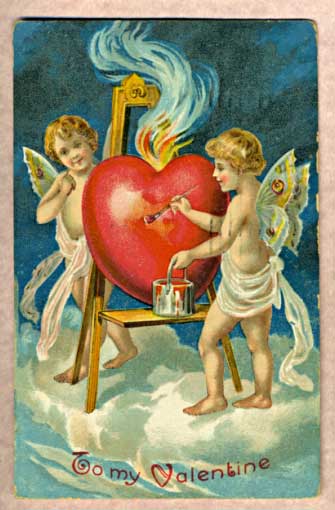
Saint Valentine’s day

Today is Valentine’s day and I am yet to meet the person who enjoy’s this day as it is supposed to be enjoyed. If you are single, it is a depressing reminder of that situation even for those who for the other days of the year are perfectly happy, something creeps in on Valentine’s day. For those in a couple it is another day in the year to spend money on presents, chocolates, cards, pink Champagne and so on and so on.


Antique Valentine’s card

So to start ‘ATELIER TALLY Paper Week‘, I wanted to trace us back to the origins of the Valentine’s card in hope of a meaning I can enjoy.

So, it is 14th February 400 BC (stay with me people) and the Romans are having a festival to partner two young people. Names of teenage women put in a box and drawn at random by adolescent men. The winners are legally-partnered for one year.

This was all that was allowed as Emperor Claudius had banned marriage for the sake of better soldiers however a Christian bishop, Valentine, began secretly marrying people. Angered by this, Claudius had Valentine killed on 24th February 270 AD (that isn’t a typo, it was not the 14th February).

The festival changed and became a day to find love. Later it was named in honour of the Saint Valentine who had tried to keep love alive.


Esther Howland Valentine, circa 1850: “Weddings now are all the go, Will you marry me or no”?

So onto some papery fun… many years later on, women in Europe carried lace handkerchief’s and if a woman dropped her handkerchief, a man nearby might pick it up and return it to her. Sometimes a woman might see a man she wanted to flirt and meet. She might drop her lace handkerchief on purpose to encourage romance. Soon people thought of romance when they thought of lace. They began using paper lace to decorate chocolate boxes and Valentine cards.

And so the tradition began. The earliest known card that still exists is currently in the British Museum. It was sent by Charles, Duke of Orleans to his wife. He was a prisoner in the Tower of London at the time and so his feelings of love were probably more acute than most!

The first manufactured Valentine’s card was by an American Esther Howland charging $35 back in 1870, using paper lace in her designs based upon the earlier flirting techniques.


Valentine card, 1862: “My dearest Miss, I send thee a kiss” addressed to Miss Jenny Lane of Crostwight Hall, Smallburgh, Norfolk.


Folk art Valentine and envelope dated 1875 addressed to Clara Dunn of Newfield, New Jersey

Modern day has changed this tradition somewhat, although there is a lot of creative still alive around the showing of love on this one day of the year.

I love this video and all of it’s papery goodness. It even made a cynic like me smile…

So, if you are yet to give a Valentine’s card, remember that Saint Valentine died for love and over the years we might have manufactured cards but the meaning remains. Write a note to someone and send to someone who presses your buttons.


Further reading:
telegraph.co.uk/relationships/valentines-day/7187784/History-of-Valentines-Day.html
wikipedia.org/wiki/Valentine’s_Day


Copyright © 2008–2012. All rights reserved.

This blog is proudly powered by Wordpress and uses a highly-customised version of Modern Clix, a theme by Rodrigo Galindez.