

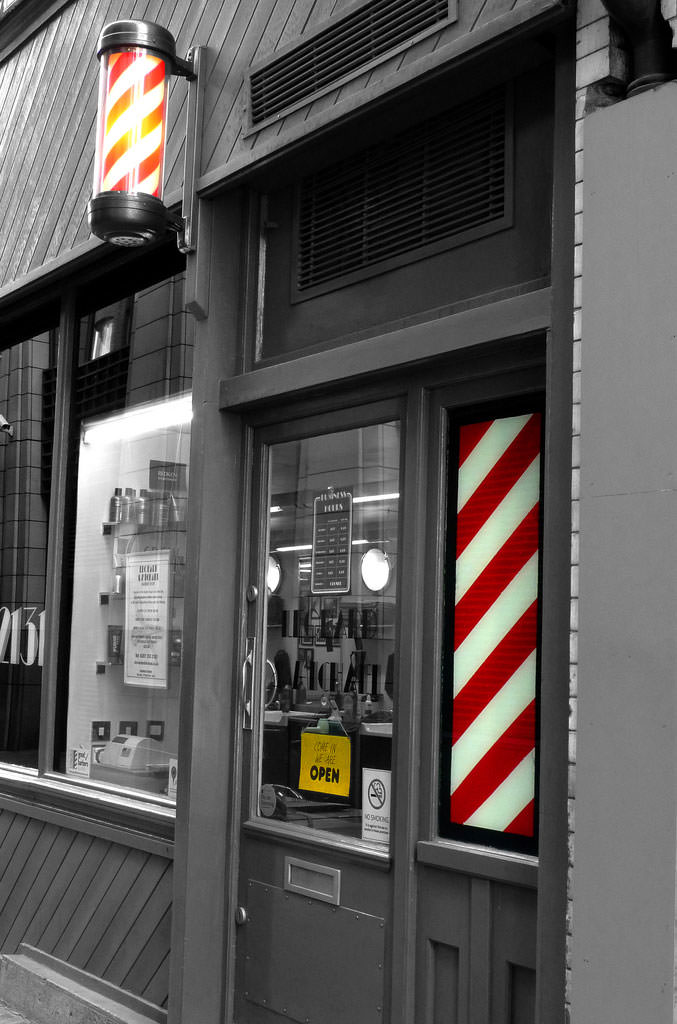
Barbers (from the Latin barba, “beard”) are most primarily known for hair cutting, and as we know can be identified by the red and white stripes outside. They generally do not offer significantly styled haircuts when compared to hairdressers working in hair salons, however, this profession has a long and extremely varied history…
Photo courtesy chris5aw
It is said that the history of the barber dates back as far as the 7th or 8th century when barbers were known as surgeons and were generally charged with looking after soldiers during or after a battle. In this era, surgery was not generally conducted by physicians, but by barbers. They often took up residence in castles where they also provided medical assistance to the rich and wealthy.
In 1904 they formed an organisation and received formal recognition of their skills (in England at least) in 1540, when the Fellowship of Surgeons merged with the Company of Barbers to form the Company of Barber-Surgeons.
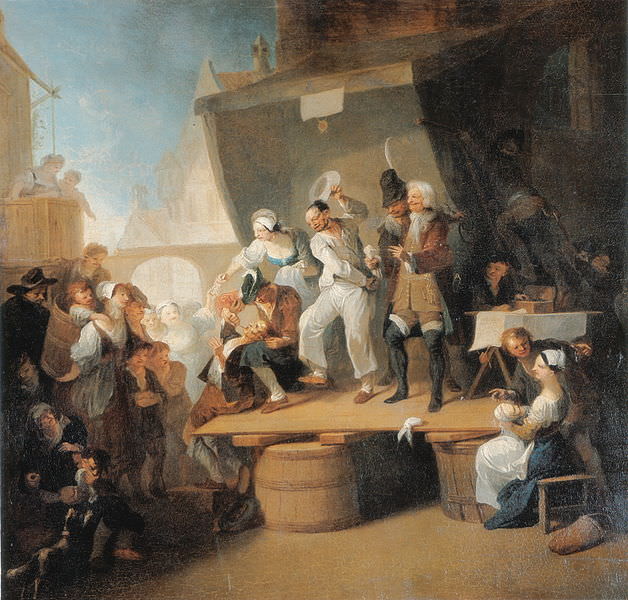
Franz Anton Maulbertsch’s The Quack (c. 1785) shows barber surgeons at work.
This practice continued until 1745 when the Company of Surgeons (in 1800 renamed the Royal College of Surgeons) was created to split the professions.
The last vestige of barber surgeons’ links with the medical side of their profession is probably the traditional red and white barber’s pole, or a modified instrument from a black smith, which is said to represent the blood and bandages associated with their past role.
It is a fascinating design whereby the spinning pole is the basis for the motion perception optical illusion, in which the stripes appear to be traveling down or up the length of the pole, rather than around it.
In the US, the barber’s pole has a blue stripe along with the red and white; the blue stripe was a 1900s nod to American patriotism. In 1950 William Marvy began producing this new design and is now America’s last barber pole manufacturer.
The original pole had a brass basin at the top (representing the vessel in which leeches were kept) and bottom (representing the basin which received the blood).
The barberpole illusion, or effect, is a visual illusion that reveals biases in the processing of visual motion in the human brain. When a diagonally-striped pole is rotated around its vertical axis (horizontally), it appears as though the stripes are moving in the direction of its vertical axis.
It is said that the barber’s pole rotates in this manner as a representation of the staff that the patient gripped during the procedure to encourage blood flow. Spinning barberpoles are supposed to be oriented so that the red (blood) will appear as if it was flowing down.
You can read more about the Barber’s pole on the Wikipedia page.


2 Comments